
Plan the day
Give suppliers controlled booking options and let the warehouse see capacity, bays, time slots and approvals in one calendar.
LoadBooker brings dock booking, approvals, arrivals, QR gate checks, issues and evidence into one operational workflow — deployed in a dedicated environment for your site.
Available for evaluation · Dedicated deployment · Founder-led discovery and support
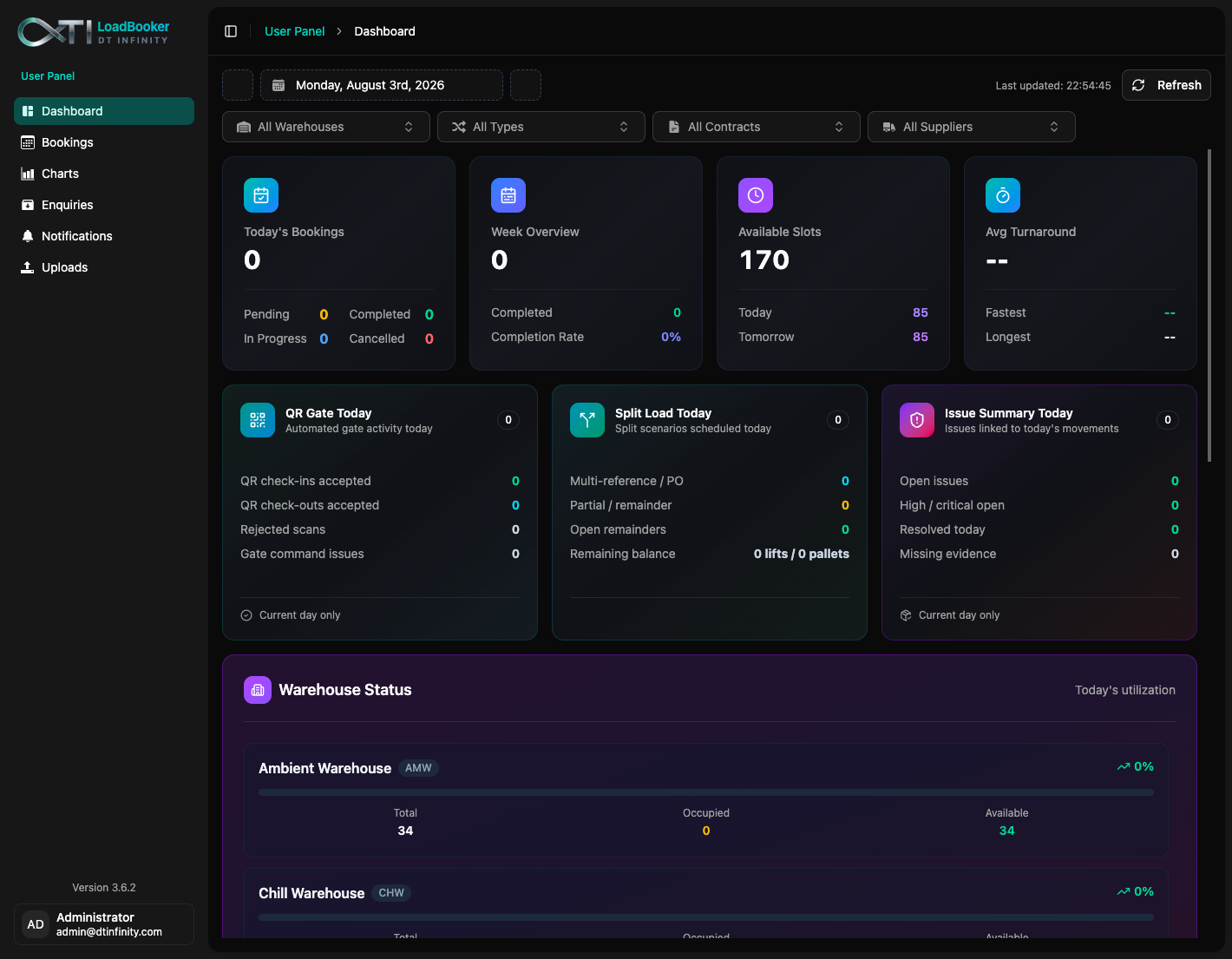
LoadBooker does not replace your WMS or ERP. It controls the operational space between a booking request, the loading bay and the evidence left after the vehicle departs.
Give suppliers controlled booking options and let the warehouse see capacity, bays, time slots and approvals in one calendar.
Track arrival, check-in, loading or unloading, issues and departure without relying on calls and disconnected messages.
Retain decisions, timestamps, QR gate records, issue evidence and audit history against the movement that created them.
The current focus is helping warehouse teams evaluate LoadBooker against a real dock-booking and movement process. Register remains visible below, but it is a separate product still in development.
A warehouse dock-booking and movement-control platform that replaces fragmented booking emails, phone calls and spreadsheets with one controlled operational workflow.
A dedicated equipment register for lifecycle records, assignments, stock verification and controlled imports.
Register is not currently presented as a finished general-availability product. Early conversations help shape priorities and deployment requirements.
A LoadBooker deployment has its own application, database, storage and licence. Hosting, backup and support responsibilities are agreed before go-live so ownership is explicit.
DT Infinity is at the stage of speaking directly with operational teams. That means honest product boundaries, short decision paths and direct access to the person building and supporting the system.
LoadBooker already covers warehouses, bays, contracts, suppliers, bookings, movements, issues, evidence and reporting.
Each customer receives an isolated environment rather than records held beside unrelated customers in one shared application database.
Discovery, deployment and support remain close to the person responsible for the product and its technical decisions.
Systems are designed for European data expectations and operational time semantics, including Europe/Dublin business time where applicable.
We do not assume that every warehouse or asset register follows the same process. Scope, responsibilities and success criteria are agreed before deployment.
Map the current process, user groups, operational rules, volumes, data sources and integration requirements.
Define the product fit, dedicated environment, configuration, data work, training and measurable acceptance criteria.
Use auditable records, agreed support arrangements and documented deployment and recovery procedures.
Role-aware access, protected administration and operational history are part of the product model rather than an afterthought.
Product licences are signed and cached locally, with a defined grace period so a temporary licence-service outage does not immediately stop operations.
Deployment tooling supports encrypted backups, external copies, readiness checks, checksummed manifests and software bills of materials.
LoadBooker is a working application available for evaluation and dedicated deployment. The interface shown on this page is a real product screen. The exact fit still needs to be checked against your warehouse workflow, integrations and operating rules.
No. LoadBooker focuses on dock scheduling and warehouse movement control. It is designed to sit alongside stock and finance systems, with supported data flows scoped per customer.
Yes. DT Infinity is currently looking for warehouse teams willing to assess LoadBooker against a real process. There are no invented customer logos or performance claims on this page; the aim of the first conversation is to establish whether the product genuinely fits the operation.
Depending on the agreed deployment, a product can run on a dedicated EU environment managed for the customer or on customer-controlled infrastructure. The hosting, backup and support responsibilities are documented before go-live.
Register is a separate asset-lifecycle product in active development. It is not presented as a finished general-availability product and is not required to evaluate or use LoadBooker.
The first conversation is a fit check, not a sales performance. Describe the current booking and movement process and you will get a direct answer about what LoadBooker already covers, what needs configuration and what would require further work.